
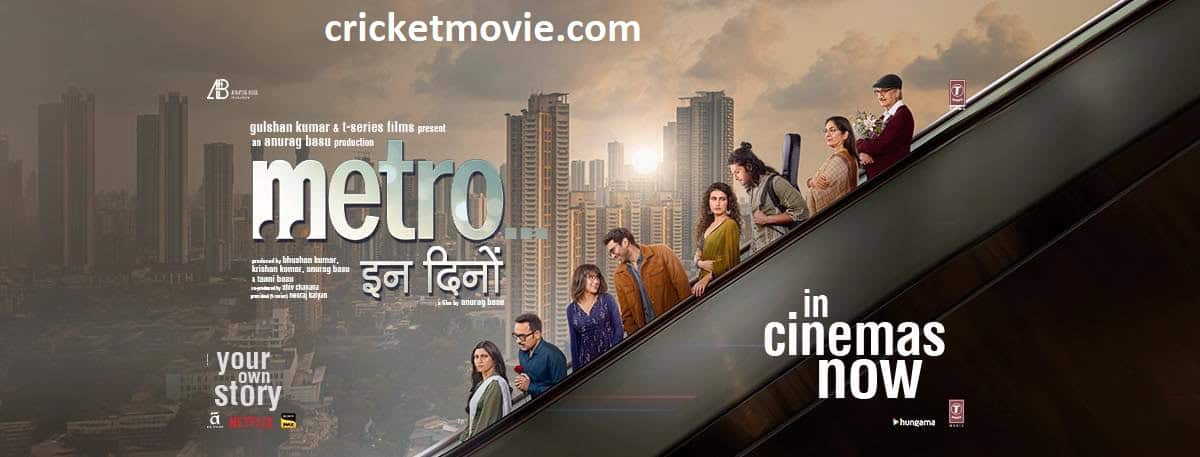
Metro In Dino Review: Soulful musical romantic drama film that beautifully explores the human relationships across different generations in contemporary times
Metro In Dino Movie Rating: 4 Stars
Watched Metro In Dino movie in Cinema. Let’s focus on the complete details, story, positive/negatives and at last my personal view on this movie.
Cast: Anupam Kher, Neena Gupta, Konkona Sen Sharma, Pankaj Tripathi, Aditya Roy Kapur, Sara Ali Khan, Ali Fazal and Fatima Sana Shaikh
Director: Anurag Basu
Release Date: 4th July 2025 in cinemas
Story: Set in different Indian metro, Mumbai, Delhi, Kolkata, Bangalore, and Pune, it is the story of four contemporary couples. Monty (Pankaj Tripathi) and Kajol (Konkona Sen Sharma) reside in Mumbai and have been married for nearly two decades. Their relationship might seem perfect from the outside, but they have differences, and as a result, they keep arguing all the time. His colleague suggests that he should download a dating app and initiate an extramarital affair. He believes that this would reignite the spark in his marriage. Things take an ugly turn when she catches her husband on a dating app and then catfishes him into an embarrassing setup. On the brink of divorcing, she heads back to her parents’ place, leaving Monty high and dry and desperate to win her back.
Kajol younger sister Chumki (Sara Ali Khan) works in Delhi as an HR professional. She is a self-confessed confused person, is all set to marry a safe option Anand (Kush Jotwani) who shrugs too much and is never able to take a stand for her. A chance encounter with travel blogger Parth (Aditya Roy Kapur) makes her question her life choices. The man spews facts to Chumki but is a commitment-phobic, playboy man-child refusing to settle down.
Parth’s college friends Shruti (Fatima Sana Sheikh) and Akash (Ali Fazal) are much in love and married couple who have to now deal with an unplanned pregnancy. While Shruti is willing to go with the flow, Akash feels child and a regular corporate job will derail his dreams of becoming a musician. Realizing that Akash is struggling with his job, she decides to opt for an abortion and shift to Delhi for better career prospects. Akash lands in Mumbai and begins to struggle while trying his luck in the film industry.
Kajol and Chumki’s mother Shibani (Neena Gupta) is stuck in a dead-end relationship with her husband and the girls’ father, Sanjeev (Saswata Chatterjee) for decades. He dictates and she listens that’s how her life has been all these years until a college reunion makes her meet her ex-boyfriend Parimal (Anupam Kher) who is a man she had truly loved but could never marry as he never fought for her and let her go.
Parimal is now a disgruntled man living a lonely life with his widowed daughter-in-law, Jhumki (Darshana Banik). While Parimal wants her to move on with life and remarry, the duties and promises made to her late husband stops Jhumki from leaving him. Parimal then takes a drastic step and offers a role of a lifetime to Shibani to a star on stage during her college years, to convince Jhumki to move on. What happens to the relationship stories?
Positives
1. Performances
2. Cinematography
3. Story
4. Direction
5. Music
6. Dialogues
Negatives
1. Length
2. Uneven Screenplay
3. Climax
Durgesh Tiwary’s View: When I watched the trailer of this film planned to watch this movie in cinemas as loved the trailer especially its music. When it comes to matters of the heart, one shoe doesn’t fit all. Multiple people across ages and cities discover this the hard way, as they grapple with evolving relationships in times of modern love and its unsurety.
Falling out of love is normal. How you manage to fall back in love with the same person over and over again, defines a relationship’s longevity. Modern love can label this as toxic; traditional love can see this as a significant compromise to stay committed. There are no rights and wrongs in love, or are there? Anurag Basu’s 2007 ensemble film ‘Life in a Metro’ was an ode to love and survival in Mumbai. The film comprised great actors, riveting stories while letting Mumbai rain be the main character. 18 years later, he takes his fascination for changing relationship dynamics and perception of love in the digital age a notch ahead. Barring a few loose ends, Basu pulls it off even when it looks like he’s winging it. His conversational storytelling keeps things light and breezy even in times of sorrow and distress. When the actors are not miming, Pritam, Papon and Raghav Chaitanya stay constant as Sutradhars through their music, so expect a plethora of songs, making this a true-blue romantic musical. The beauty of this film lies in its setting. Basu doesn’t just tell stories – he stages emotions. Rain drizzles like a soundtrack. Cities breathe in the background. Love unfurls at a bus stop, on a footpath, under a dim streetlight. The mundanity of these locations is what makes them magical – streets you might have walked on, cafes you might have passed by. That familiarity lends the film its quiet charm, as if reminding us that the most romantic moments are often the most ordinary.
The stories in Basu’s romantic universe are interesting, believable, and very romantic. Their conflicts are familiar, and their joys are worth celebrating. An older woman wanting to live her youth at a college reunion, a husband chasing his wife to Goa to apologies, a wife refusing to give up on her husband during hard times, or two strangers falling in love – you feel like you’ve known these people. You’ve perhaps been one of them. The performances are unmissable, and the writing, sharp. The film doesn’t promise a larger-than-life drama. It celebrates life as it is: messy, warm, imperfect, and beautiful. The cities and their chaos and silence become part of the narrative. The visuals seem soaked in poetry be it traffic flowing past glass windows, lovers talking on balconies overlooking skylines, yellow taxis in Kolkata zipping past the characters, Basu doesn’t show you cities, he makes you feel them, speak to them. This is not a one-toned film. It’s vibrant, colorful, textured, and leaves you with a smile when the credits roll. For audiences yearning for a romantic film that feels both meaningful and breezy, this is it. The music, by Pritam Chakraborty, deserves its moment. It doesn’t decorate the film, it defines it. Without it, the anthology wouldn’t be what it is a lived-in, melodic experience. The songs elevate the story into a memory.
The film can be confusing at times, making it essential to watch with full concentration. The beginning 10 minutes are a bit odd as Anurag Basu just throws you into their world without a conventional introduction of the characters. Hence, one might feel disconnected initially, though the film picks up well. Despite being largely pleasant, some tracks don’t quite add up, feel uneven and don’t know where to end. After an engaging build up, the second half feels a tad stretched. You also wish the story scratched the surface a little more, especially for Konkona-Neena Gupta track, where the actors have the potential and gravitas to dig deeper. The film tries to address modern love but ends up normalizing infidelity and emotional neglect without consequences or introspection. It’s disjointed and lacks the emotional core that made the original memorable. Ali Fazal and Fatima Sana Shaikh are forgettable to the point of being irrelevant. A talented ensemble sadly wasted. It suffers from its length and scattered structure. Even for long-time admirers of Basu’s work, the film can feel exhausting at times. Unlike some of his earlier films that flow effortlessly, this one struggle to have cohesiveness. The various storylines don’t come together as seamlessly as one would hope. The climax, where each protagonist seemingly experiences a sudden “eureka” moment, feels random and underdeveloped. It it falters due to a somewhat muddled and inconsistent plot. Some storylines feel undercooked or implausible. For instance, why is Shruti working at a bookshop in Mumbai when, as a trained journalist, she could easily continue in her own field? Why does Parth, a self-declared nomad, suddenly settle for an arranged marriage, with a woman we never even meet? Why doesn’t Parimal have a more meaningful conversation with Jhunuk and help her carve out her own future? The heightened theatricality of that subplot feels misplaced.
It is an important film for it talks of love, of compatibility, of second chances, and of companionship at a time when one chooses soul mates by swiping right. When projecting a happy image on social media becomes more important than being actually happy and content and tries to assess how relationship dynamics have changed with time and how it’s important to keep making efforts in love. Overall, movie lets you feel. Every frame looks straight out of an art exhibition, and every song conveys something. This is cinema at its beautiful, honest best. It is an earnest attempt at genuine storytelling, something which most directors of today have become negligent about. It stands out as a refreshing, one-of-a-kind musical entertainer that thrives on its relatable characters, engaging mix of humour and drama, and stellar performances. My view on this movie Highly Recommended.
For more Movies and Cricket updates visit my page on Facebook Durgesh Tiwary’s View and website Cricket Movie Website